
Before You Buy AI for Daily Reports, Follow One Crew’s Work

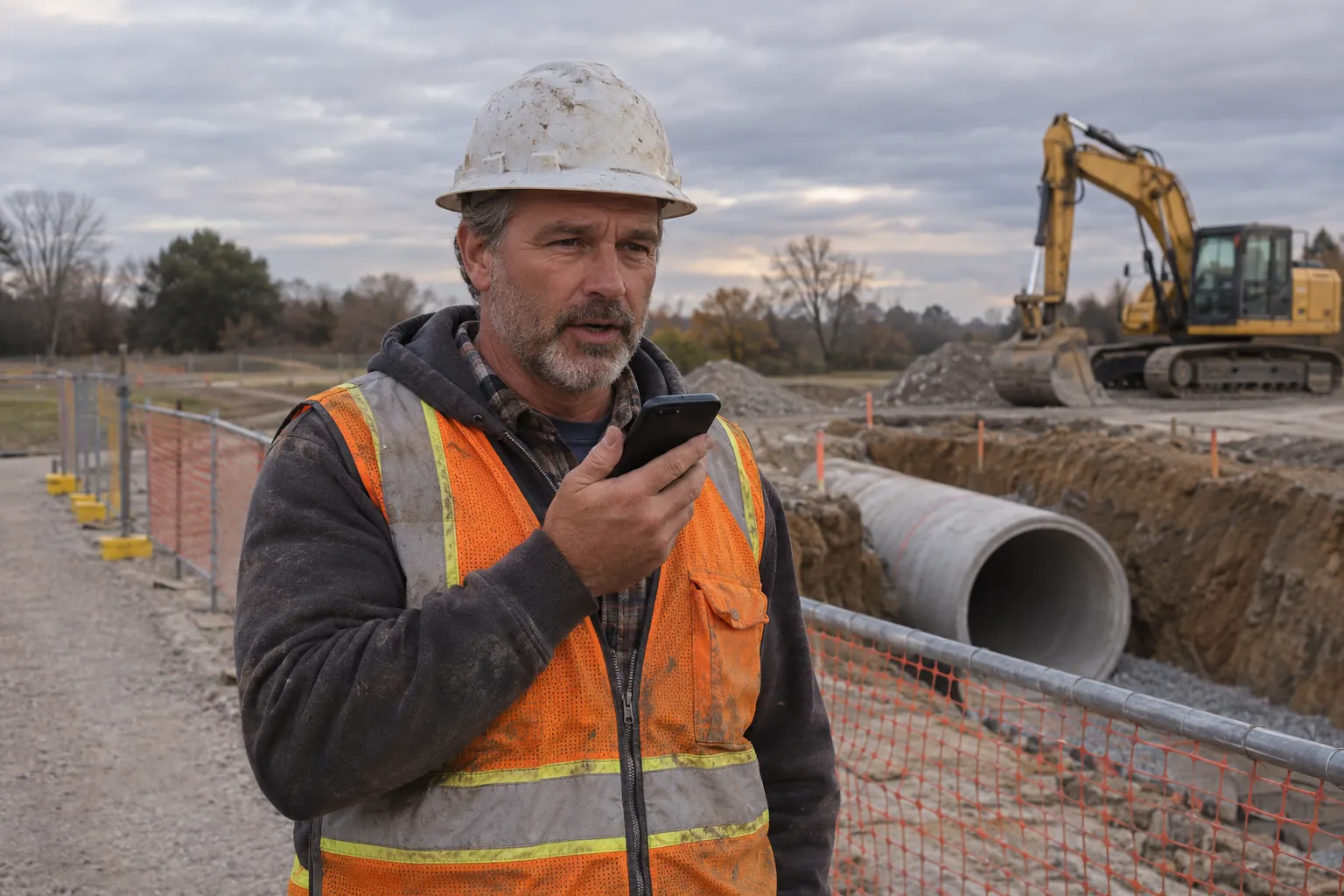
A foreman finishes a voice note on the phone. A daily report appears, neatly written and ready to send. That could save useful time. But before approving a rollout across the company, ask what happens to the information after the report is filed.
Can the superintendent see what the crew actually installed? Can the project manager compare those quantities with the hours charged to the work? Does the person preparing the job forecast get the information while there is still time to change the plan?
As you set next year’s technology budget, those are better tests than how quickly a tool turns speech into paragraphs.
Follow a pipe crew through one day
Take an illustrative civil job. The crew installs 40 meters of storm pipe. Six people each work eight hours. One excavator operates for six hours and waits two hours for access. Four truckloads of stone arrive. The foreman records a utility conflict that interrupted the sequence.
A useful record connects those facts to the date, work location and activity. It distinguishes pipe installed from pipe delivered, records the pipe size, and keeps the stone tickets with their measured quantities. Four loads alone do not tell purchasing or cost control how much material was received.
The arithmetic gives 48 labor-hours for 40 installed meters, or 1.2 labor-hours per meter, if all those hours belong to that activity. That is a starting point for a conversation, not proof the crew performed well or badly. The planned rate, trench conditions, depth, shoring, rework and work included in the quantity all matter.
If half the crew spent the afternoon on another activity, charging every hour to the pipe installation gives the project manager the wrong picture. A polished narrative will not correct that allocation.
Give each record a job
The foreman should not have to enter the same hours into three forms. Agree which record holds the approved time, which holds installed quantities and which holds equipment use. Match them through the same project, date, work location and cost code, at a level the field can maintain.
Payroll still needs its time approvals and applicable pay rules. Equipment management needs to distinguish operating time, waiting time and availability. The superintendent needs quantities and constraints to plan tomorrow. Finance needs approved costs and a clear explanation of remaining work. One report can support those needs without becoming the approval for all of them.
This is not a new reason to collect more paperwork. Wisconsin DOT’s daily work report guidance, updated April 27, 2026, separately records personnel hours, equipment use and idle hours, and item quantities with location. These are an owner’s inspection records, not a universal form for contractors. They illustrate why attendance, equipment and completed work need more than one field.
Let AI ask for what is missing
In a pilot, test whether voice capture works with the crew’s language, site noise and connectivity. A foreman should be able to add observations during the shift, correct a mistaken number and finish the report without repeating the whole day. Check how offline entries, failed uploads and revised quantities are handled.
We would require the assistant to flag a missing unit or an unclear location rather than fill it in. It should not infer eight operating hours because an excavator was listed on site, or report a delivery as installed work. NIST’s July 2024 Generative AI Profile describes the risk of confidently stated false content. Our practical response is to keep the foreman’s source entries, identify unresolved details and require a named reviewer before the draft becomes the approved daily record.
A later correction should leave a trace. Access and retention for voice notes, photos and reports also need to be agreed before field teams start using the tool. FHWA’s inspection guidance calls for factual, signed, reviewed daily records and a trail between work performed, measured and paid. The contract and jurisdiction determine the actual record requirements on your jobs; an AI-written report does not change them.
Keep building and civil work recognisable
For a self-performing civil contractor, pipe length, excavation volume, haulage, labor-hours and equipment hours can support production tracking. On a building job, the useful quantity might be formwork area, concrete volume or completed rooms, with the work location clearly identified.
For subcontracted work, record the trade’s progress and constraints without pretending that a GC’s headcount observation is the subcontractor’s payroll or cost record. Delivered, installed, inspected and accepted may be different stages. Decide which stage the team is reporting before comparing projects.
Buy the complete working routine
Before expanding the pilot, have the foreman, superintendent, project manager, payroll and cost-control team follow one week’s records together. Can they find the same activity, explain a production shortfall and update the plan without rebuilding the report in a spreadsheet? Measure preparation time, correction time and missing information. A quick draft that takes the office an hour to repair has not finished the job.
At Boris & Associates Inc., we help contractors put these field, project and finance responsibilities together as part of enterprise construction transformation. We start with what the company needs to know, agree who records and approves it, then test the information flow and the tools on active work.
If daily reporting is in your next technology budget, let’s trace one crew’s day before you commit to a company-wide rollout.
READ THE LATEST NEWS
Before You Buy AI for Daily Reports, Follow One Crew’s Work
A faster daily report only helps if the quantities, hours and delays reach the people planning the work and forecasting the job. Start with one crew.

After the Acquisition, the Jobs Still Start Monday
You bought a contractor with good people and active jobs. Now the teams need to know who can approve purchases, move equipment and stand behind the job forecast.

Before You Bid the Job, Can Your Team Actually Staff It?
A bid can look profitable on paper and still overcommit the people needed to deliver it. Here is a practical capacity check for general contractors before the promise is made.